However, it is a severe over-simplification to assert that policy "in the modern world is economics" (p63). Much of the policy pursued in the modern world has little to do with economics, and much more to do with naked commercialism and mercantilism (protection of established producer interests) - which is exactly counter to the thrust of economics. Witness the arguments about trade liberalisation, which economics says will make consumers (households) better off, even if it damages existing producer interests in the short term. It is easy to confuse economics with commerce, but it does not help to do so. Economics is about making logical choices on well stated and logical premises - policies are the result of practical political choices on (frequently) well disguised and often confused premises.
It is also seriously questionable that "sustainable development" can mean what anyone wants it to mean - "you can claim anything to be sustainable development" (p 63). Slavery? Fascism? Genocide? If you are willing to judge these sustainable, I will have to reconsider my willingness to respect your opinions and arguments on this subject. There are sensible boundaries to the meaningful concepts of both sustainable and development, even if these boundaries are difficult to define in a commonly acceptable manner. It is counter-productive to suggest that the phrase is simply a facade behind which the usual suspects can continue their anti-social and amoral hegemony over the world. For the most part, these charlatans (whoever they are) have been obliged to sign up to the concept of sustainable development - it is up to us to expose their mendacity as and when they do not live up to their rhetoric - by not buying their products, and not voting for them, and by exposing their arguments as ridiculous them at every opportunity.
Is development necessary? Why not simply stop pursuing growth (as a synonym for 'development')? After all, there is no evidence that economic development makes people happier. Our rampant consumer society, complete with its rat-race aspirations, is the root cause of the problem. Well, maybe, on a different planet. Happiness is clearly both relative and also frequently virtual (as opposed to real) - how content are we with our present lot compared with what we imagine it might or could be like?
Meanwhile, let me know when you find a working majority willing to put their money where their mouths are when they agree with proposition, and I will applaud and even praise the lord. Until then, I will continue to try and deal with the real world, in which continued development is necessary, but not sufficient, to pursue a more sustainable set of processes.
This is NOT to say that we should not remember the seven deadly sins: sloth, greed, envy, lust, pride, gluttony and anger; or that we should not try and design and promote social institutions (as rules and codes of behaviour) which discourage these sins - long recognised as ultimately foolish behaviours (however apparently justified some may be in the instant). By the same token, we would be wise to encourage behaviours which are traditionally regarded as virtuous: faith, hope, charity, prudence, temperance, fortitude and justice - long recognised as being wise courses for the continued survival and replication of human (as opposed to animal) life.
By any measure, our current pursuits of development leave much to be desired, and thus much to be done to improve them, and the institutions which we use to develop ourselves. You are important people in this pursuit - it would not be wise of you simply to decry the real world as an unfit place in which to live without trying to do something useful about it. You would be wise to try and practice humility, diligence, liberality and patience while you do so (which, I freely admit, I do not always manage).
Meanwhile, also, you should consider the arguments of someone who is conspicuously absent from Dresner's bibliography: Fred Hirsch (a British Economist): The Social Limits to Growth (Harvard University Press, 1976). Writing in the immediate aftermath of the Club of Rome's Limits to Growth, which he dismissed as nonsense (in common with most other serious modelers of the human condition). He argued that continued pursuit of material possessions as a route to happiness will eventually be confounded by the 'if everyone stands up, no one sees any better' syndrome. Many of our present material pursuits are for 'positional' goods - those whose value derives from their rarity, and the fact that very few other people have them. Clearly, we cannot all have these - if we did, they would lose their value completely. This pursuit of positional goods is clearly self-defeating.
However, unremarked by Hirsch, it is perhaps understandable as an instinctive (animal) reaction - ideal feeding positions, for instance, are clearly of considerable survival benefit, and are occupied by those individuals at the top of the heap in the animal kingdom, and fought over jealously. More purposefully careful humans might be expected to behave differently, and perhaps will eventually learn how to - by differentiating themselves from their fellows in different ways - bespoke lifestyles rather than status lifestyles perhaps. Just because the last 200 years or so have been characterised by mass production, and the consequent attraction of positional goods as differentiators, does not mean that this is the final climax condition of the modern human.
"Much of what is conventionally called 'development' is really about joining a rat race of meaningless additional consumption" (p 74) Well, maybe, but where does this get us? The only course, then, is to convince those who have not got as much as we think we need that they do not really need as much as we have - go and try it, and let me know how you get on!
Happiness and economic growth:
For an economic assessment of the pursuit of happiness and its implications for policy, see Layard, 2006, "Happiness and Public Policy: a Challenge to the Profession", Economic Journal, 116 (March)" "The most obvious explanations come from three standard findings of the new psychology of happiness:
First, a person’s happiness is negatively affected by the incomes of others (a negative externality).
Second, a person’s happiness adapts quite rapidly to higher levels of income (a phenomenon of addiction).
Third, our tastes are not given – the happiness we get from what we have is largely culturally determined."
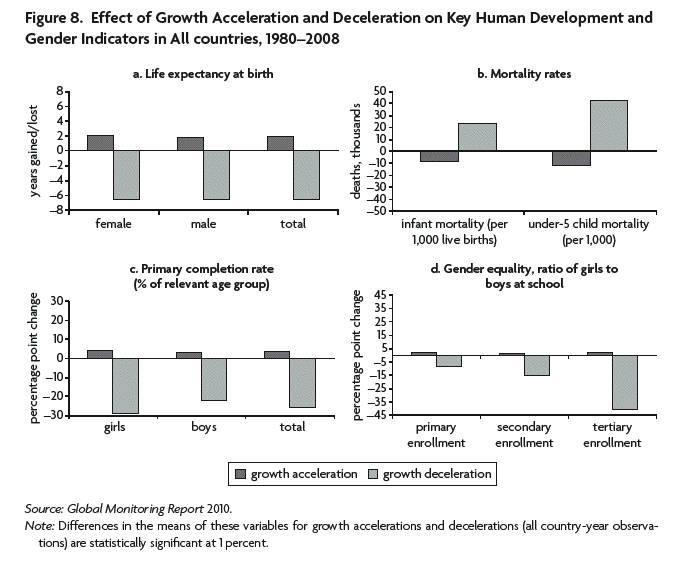
Check out the World Values Survey site for cross time and country comparisons: (Fig LHS from World Values Survey - collection of graphs representing WVS data. - RHS from World Bank Global Monitoring Report, 2010. (The Global Monitoring Report series, produced by the World Bank and the International Monetary Fund, focuses on how the world is doing in implementing the policies and actions for achieving the Millennium Development Goals (MDGs) and related development outcomes. The reports are a framework for accountability in global development policy.)
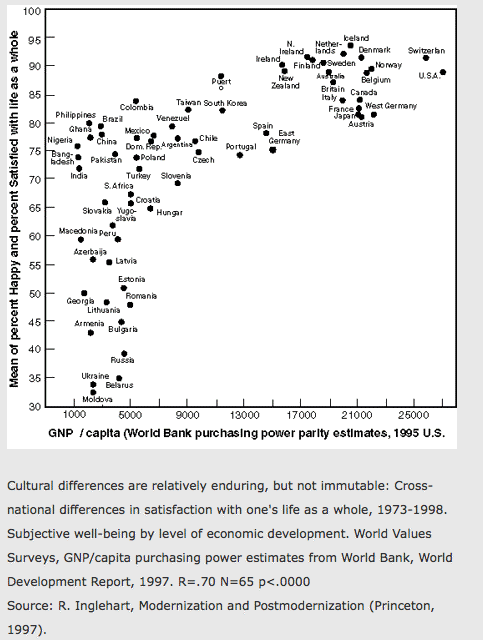
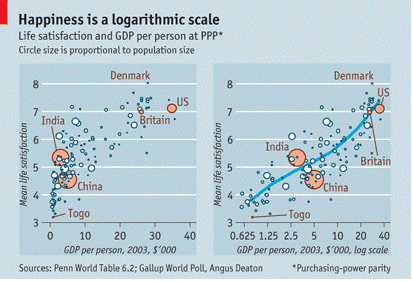
Notice, however, that the correlation between Life Satisfaction and GDP (lhs above) is represented as linear - $1000 extra income (GDP/hd) would not be expected to generate the same increase in life satisfaction for someone (country) who already has $25,000 as for someone (country) who only has $5,000. "All this chart realy shows is that an extra dollar is worth less to the rich than to the poor. The interesting question is whether the same percentage increase in income means as much to a rich country as to a poor one." (Economist, 27.11.10: The Joyless or the Jobless)
See, also: OECD, European Commission and others: Beyond GDP: Measuring Progress, true wealth and the wellbeing of nations,
and also the Commission on the Measurement of Economic Performance and Social Progress. and their recent (2009) report. "The Commission’s aim has been to identify the limits of GDP as an indicator of economic performance and social progress, including the problems with its measurement, to consider what additional information might be required for the production of more relevant indicators of social progress, to assess the feasibility of alternative measurement tools, and to discuss how to present the statistical information in an appropriate way. ...Policies should be aimed at increasing societal welfare, not GDP. Choices between promoting GDP and protecting the environment may be false choices, once environmental degradation is appropriately included in our measurement of economic performance. This report, building on extensive earlier work, describes the additions and subtractions that can and should be made to provide a better measure of welfare."
See, also, the New Economics Foundation: Happy Planet Index, 2009. "The Happy Planet Index (HPI) provides that compass by measuring what truly matters to us - our well-being in terms of long, happy and meaningful lives - and what matters to the planet - our rate of resource consumption. The HPI brings them together in a unique form which captures the ecological efficiency with which we are achieving good lives. This report presents results from the second global HPI. It shows that we are still far from achieving sustainable well-being, and puts forward a vision of what we need to do to get there." A recent poll (2012) suggests that GDP/hd. is not a good predictor of (self-reported) happiness, which is hardly a surprise, is it? 'Finally', see Graham, 2005, World Economics, which examines "the gap between economists’ assessments of the aggregate benefits of the globalization process and the more pessimistic assessments that are typical of the general public. The paper summarizes research on some of these questions, and in particular on those relevant to globalization, poverty, and inequality."
What makes us happy?
Dan Gilbert (author of "Stumbling on Happiness") - The Surprising Science of Happiness. challenges the idea that we’ll be miserable if we don’t get what we want. Our "psychological immune system" lets us feel truly happy even when things don’t go as planned. In the same way that optical illusions fool our eyes -- and fool everyone's eyes in the same way -- Gilbert argues that our brains systematically misjudge what will make us happy - our experience simulators frequently get things wrong - the Impact Bias - tendency to (substantially) overestimate the hedoninc impact of future events. And these quirks in our cognition make humans very poor predictors of our own bliss, but enable us to synthesise our own happiness - how we 'rationalise' our actual condition, our actual choices (which we then pre-suppose are the right ones (sometimes - see Schwartz below)). Freedom to choose helps 'actual' happiness, but really hurts synthetic happiness - we find a way to be happy with what we cannot change (and conversely - Schwartz below - be less happy if we can change things).
- and a set of 8 other related mini-lectures on What Makes us Happy? including
Malcolm Gladwell (author of "Tipping Point") : Choice, happiness and spaghetti sauce. - people can't tell you what they want, until and unless you give them a choice (Henry Ford - as people what they want, and they will tell you a faster horse; and also people won't necessarily admit to what they really like) - there is no single recipe to please all the people all the time - no universals - people are different, and have (identifiably different) tastes (and cultures?) - diversity is the key to happiness.
Mihaly Csikszentmihalyi: Flow, the secret to happiness - creativity is a central source of meaning in our lives. A leading researcher in positive psychology, he has devoted his life to studying what makes people truly happy: "When we are involved in [creativity], we feel that we are living more fully than during the rest of life." He is the architect of the notion of "flow" -- the creative moment when a person is completely involved in an activity for its own sake.
Michael Norton: How to buy happiness - money can, indeed buy happiness -- when you don't spend it on yourself. Listen for surprising data on the many ways pro-social spending can benefit you, your work, and (of course) other people - positively encouraging philanthropy might be a genuine Pareto Improvement (nobody loses)?
Barry Schwartz: The paradox of choice - choice has made us not freer but more paralyzed, not happier but more dissatisfied - choice is not the same thing as freedom. Too much choice leads to -unreasonably high expectations, question our choices before we even make them and blame our failures entirely on ourselves (with every choice available, there is no rational justification for failure - other than you - the peculiar and specific problem of modern affluence) - Income redistribution makes everyone better off.
Graham Hill: Less stuff, more happiness
Matthieu Ricard: The habits of happiness - Biochemist turned Buddhist monk Matthieu Ricard says we can train our minds in habits of well-being, to generate a true sense of serenity and fulfillment.
Daniel Kahneman: The riddle of experience vs. memory - our "experiencing selves" and our "remembering selves" perceive happiness differently - being happy in your life is different from being happy with your life - and it is the remembering self which makes decisions (which thinks of the future as a set of anticipated memories). This new insight has profound implications for economics, public policy -- and our own self-awareness. Happiness is NOT a substitute for well-being.
Ron Gutman: The hidden power of smiling
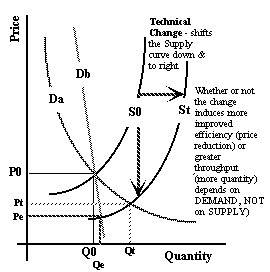 As this market diagram
illustrates, when we innovate, and generate technical change, we
actually SHIFT supply curves of products so that we can have
As this market diagram
illustrates, when we innovate, and generate technical change, we
actually SHIFT supply curves of products so that we can have