
Melissa Bateson
Professor of EthologyCentre for Behaviour & Evolution, Newcastle University.
Email: melissa.bateson@ncl.ac.uk
Link to my University web profile
On this site you can find:
And how does it affect adult feelings and behaviour?
Melissa BatesonProfessor of EthologyCentre for Behaviour & Evolution, Newcastle University. Email: melissa.bateson@ncl.ac.uk Link to my University web profile On this site you can find: |
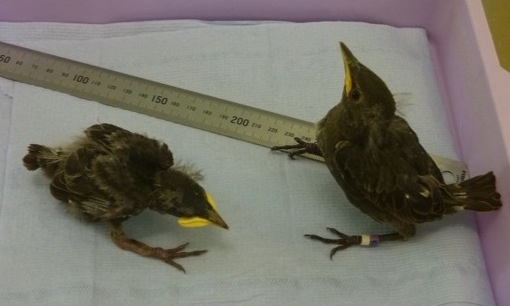
How does early-life adversity get under your skin (or feathers)? I am collaborating with Daniel Nettle to answer this question in starlings. The picture below shows 15-day old chicks from different brood sizes.
|
Tweets by @MelissaBateson
|

I am an ethologist, meaning that I take a biological approach to the study of behaviour, asking both proximate and ultimate questions about why animals behave as they do. I have broad research interests are in decision making, emotions and animal welfare. I take a comparative approach to animal cognition and I work with a range of different species from honeybees to humans. My main model system is the European starling.
Nettle, D., Monaghan, P., Gillespie, R. Brilot, B. O., & Bateson, M. (2015) An experimental demonstration that early-life competitive disadvantage accelerates telomere loss. Proceedings of the Royal Society, B, Volume: 282 Issue: 1798. PDF.Open Access.
Bateson, M., Tovee, M. J., George, H. R., Gouws, A. & Cornelissen, P. L. (2014) Humans are not fooled by size illusions in attractiveness judgements. Evolution and Human Behavior 35: 133-139. PDF.Open Access.
Nettle, D, Monaghan, P., Boner, W., Gillespie, R. & Bateson, M.(2013) Bottom of the Heap: Having Heavier Competitors Accelerates Early-Life Telomere Loss in the European Starling, Sturnus vulgaris PLoS ONE 8(12): e83617. doi:10.1371/journal.pone.0083617 PDF.
Bateson, M., Callow, L., Holmes, J. R., Redmond Roche, L. M. & Nettle, D. (2013) Do Images of ‘Watching Eyes’ Induce Behaviour That Is More Pro-Social or More Normative? A Field Experiment on Littering. PLoS ONE 8(12): e82055. doi:10.1371/journal.pone.0082055. PDF.
Dixon, L. M., Sandilands, V., Bateson, M., Brocklehurst, S., Tolkamp, B. J. & D'Eath, R. B. (2013) Conditioned place preference or aversion as animal welfare assessment tools: Limitations in their application. Applied Animal Behaviour Science. 148: 164-176. PDF.
Nettle, D., Cronin, K. & Bateson, M. (2013) Responses of chimpanzees to cues of conspecific observation. Animal Behaviour. 86: 595-602. PDF.
Feenders, G. & M. Bateson (2013). Hand rearing affects emotional responses but not basic cognitive performance in European starlings. Animal Behaviour 86: 127-138. DOI information: 10.1016/j.anbehav.2013.05.002. PDF. Open Access.
Nettle, D., Z. Harper, A. Kidson, R. Stone, I.S. Penton-Voak, and M. Bateson (2013). The watching eyes effect in the Dictator Game: It's not how much you give, it's being seen to give something. Evolution and Human Behavior34: 35-40. PDF.
Jayne, K., G. Feenders & M. Bateson (2013). Effects of developmental history on the behavioural responses of European starlings (Sturnus vulgaris) to laboratory husbandry. Animal Welfare 22: 67-78. PDF.
Eens, M., V. L. Jaspers, E. van den Steen, M. Bateson, C. Carere, P. Clergeau, D. Constantini, Z. Dolenec, J. E. Elliott, J. Flux, H. Gwinner, R. S. Halbrook, P. Heeb, T. D. Mazgajski, A. Moksnes, V. Polo,J. J Soler, R. Sinclair, J. P. Veiga, T. D. Williams, A. Covaci & R. Pinxten. (2013). Can starling eggs be useful as a biomonitoring tool to study organohalogenated contaminants on a worldwide scale? Environment International 51: 141-149 PDF.
Nettle D, Nott K, Bateson M (2012). ‘Cycle Thieves, We Are Watching You’: Impact of a Simple Signage Intervention against Bicycle Theft. PLoS ONE 7(12): e51738. doi:10.1371/journal.pone.0051738 Open Access.
Feenders, G. and M. Bateson. (2012). The development of stereotypic behaviour in caged European starlings, Sturnus vulgaris. Developmental Psychobiology. 54: 773-784. PDF.
Hutchinson, JMC, Stephens DW, Bateson, M, Couzin, I, Deukas, R. Giraldeau, L-A, Hills TT, Mery, F & Winterhalder, B. (2012). Searching for fundamentals and commonalities of search. In: Cognitive Search: Evolution, algorithms and the Brain. Ed. Todd, PM, Hills, TT & Robbins, TW. Strungman Forum Reports. pp. 47-65. PDF.
Nettle, D. and M. Bateson (2012). Evolutionary origins of mood and its disorders. Current Biology 22: R712-21. PDF.
Brilot, B. O. and M. Bateson. (2012). Water bathing alters threat perception in starlings. Biology Letters 8: 379-381. PDF.
Douglas, C., M. Bateson, C. Walsh, A. Bedue and S. A. Edwards. (2012). Environmental enrichment induces optimistic cognitive biases in pigs. Applied Animal Behaviour Science 139: 65-73. PDF.
Brilot, B., M. Bateson, D. Nettle, M. J. Whittingham and J.C.A. Read (2012). When is general wariness favored in avoiding multiple predator types? American Naturalist 179: E180-E195. PDF. Supporting online material.
Barnett, C. A., J. Skelhorn, M. Bateson and C. Rowe. (2012). Educated predators make strategic decisions to eat defended prey according to their toxin content. Behavioral Ecology 23: 418-424. PDF.
Morgan, K. V., T. A. Hurly, M. Bateson, L. Asher, S. D. Healy. (2012). Context-dependent decisions among options varying in a single dimension. Behavioural Processes 89: 115-120. PDF.
| Bateson, M., B. Brilot and D. Nettle. (2011). Anxiety: An evolutionary approach. Canadian Journal of Psychiatry 56: 707-15. PDF. |
Bateson, M., S. Desire, S. E. Gartside and G. A. Wright. (2011). Agitated honeybees exhibit pessimistic cognitive biases. Current Biology 21: 1070-1073. PDF.
Ernest-Jones, M., D. Nettle & M. Bateson (2011). Effects of eye images on everyday cooperative behavior: a field experiment. Evolution and Human Behavior 32: 172-8. PDF.
Flecknell, P., M. Leach and M. Bateson. (2011). Affective state and quality of life in mice. Pain 152: 963-964. PDF.
Feenders, G., K. Klaus and M. Bateson. (2011). Fear and exploration in European starlings (Sturnus vulgaris): a comparison of hand-reared and wild-caught birds. PLoS ONE 6: e19074. Open Access.
Feenders, G. and M. Bateson. (2011). Hand-rearing reduces fear of humans in European starlings, Sturnus vulgaris. PLoS ONE 6: e17466. Open Access.
Salmeto, A. L., K. A. Hymel, E. C. Carpenter, B. O. Brilot, M. Bateson and K. J. Sufka. (2011). Cognitive bias in the chick anxiety-depression model. Brain Research 1373: 124-130. PDF.
Brydges, N. M., M. Leach, K. Nicol, R. Wright and M. Bateson. (2011). Environmental enrichment induces optimistic cognitive bias in rats. Animal Behaviour 81: 169-175. PDF.
Brilot, B. O., L. Asher and M. Bateson. (2010). Stereotyping starlings are more 'pessimistic'. Animal Cognition 13: 721-731. PDF.
Bateson, M. and G. Feenders. (2010). The use of passerine bird species in laboratory research: implications of basic biology for husbandry and welfare. ILAR Journal 51: 394-408. PDF.
Bateson, M. (2010). Rational choice behaviour: definitions and evidence. Encyclopaedia of Animal Behavior Breed, M. D. & Moore, J., eds. In Foraging behaviour, Stephens, D., section editor. Academic Press, Oxford. PDF.
Bateson, M & Asher, L. 2010. The European Starling. In: UFAW handbook on the care and management of Laboratory Animals and Other Animals Used in Scientific Procedures. Ed. Hubrecht, R. & Kirkwood, J. Eighth edition. Wiley-Blackwell. PDF.
Brilot, B. O., L. Asher, G. Feenders and M. Bateson. (2009). Quantification of abnormal repetitive behaviour in captive European starlings (Sturnus vulgaris). Behavioural Processes 82: 256-264. PDF.
| Brilot, B. O., L. Asher and M. Bateson. (2009). Water bathing alters the speed-accuracy
trade-off of escape flights in European starlings.
Animal Behaviour 78: 801-807. PDF. Editorial in Animal Behaviour about this paper. PDF. |
Asher, L, R. D. Kirkden and M. Bateson. (2009). An empirical investigation of two assumptions of motivation testing in captive starlings (Sturnus vulgaris): do animals have an energy budget to spend? and does cost reduce demand?. Applied Animal Behaviour Science 118: 152-160. PDF.
Brilot, B. O., C. L. Normandale, A. Parkin and M. Bateson. (2009). Can we use starlings' aversion to eyespots as the basis for a novel 'cognitive bias' task?. Applied Animal Behaviour Science 118: 182-190. PDF.
Cornelissen, P. L., M. J. Tovee and M. Bateson. (2009). Patterns of subcutaneous fat deposition and the relationship between body mass index and waist-to-hip ratio: implications for models of physical attractiveness. Journal of Theoretical Biology 256: 343-350. PDF.
Asher, L, G. T. O. Davies, C. E. Bertenshaw and M. Bateson. (2009). The effects of cage volume and cage shape on the cognition and behaviour of captive European starlings (Sturnus vulgaris). Applied Animal Behaviour Science 116: 286-294. PDF.
Mason, G & Bateson, M. (2009). Motivation and the organisation of behaviour. In: The Ethology of Domestic Animals – an Introductory Text, 2nd edition. (ed. P. Jensen). CABI publishing: Wallingford, UK.
Asher, L and M. Bateson. (2008). Use and husbandry of captive European starlings (Sturnus vulgaris) in scientific research: a review of current practice. Laboratory Animals 42: 111-126. PDF.
Matheson, S. M., L. Asher and M. Bateson. (2008). Larger, enriched cages are associated with 'optimistic' response biases in captive European starlings (Sturnus vulgarise). Applied Animal Behaviour Science 109: 374-383. PDF.
Barnett, C. A., M. Bateson and C. Rowe. (2007). State-dependent decision making: educated predators strategically trade off the costs and benefits of consuming aposematic prey. Behavioral Ecology 18: 645-651. PDF.
Bateson, M. and S. M. Matheson. (2007). Performance on a categorisation task suggests that removal of environmental enrichment induces 'pessimism' in captive European starlings (Sturnus vulgaris) Animal Welfare 16: 33-36. PDF.
Smith, K. L., M. J. Tovee, P. J. B. Hancock, M. Bateson, M. A. A. Cox and P. L. Cornelissen. (2007). An analysis of body shape attractiveness based on image statistics: evidence for a dissociation between expressions of preference and shape discrimination. Visual Cognition 15: 927-953. PDF.
Bateson, M., Cornelissen, P.L. & Tovee, M.J. (2007). Methodological issues in judgements of female body Attractiveness. In: The Body Beautiful: Evolutionary and Socio-cultural Perspectives. (edited by Viren Swami & Adrian Furnham). Macmillan, Basingstoke, UK.
Bateson, M. 2007. Environmental noise and decision-making: possible implications of increases in anthropogenic noise for information processing in marine mammals. International Journal of Comparative Psychology 20: 169-178. PDF.
Wright, A. J., Aguilar Soto, N, Baldwin, A. L., Bateson, M., Beale, C. M., Clark, C, Deak, T., Edwards, E. F., Fernandes Rodrigues, A., Godinho, A., Hatch, L., Kakuschke, A, Lusseau, D, Marineau, D., Romero, L. M., Weilgart, L., Wintle, B., Notarbartolo di Sciara, G., & Martin, V. (2007). Do marine mammals experience stress related to anthropogenic noise? International Journal of Comparative Psychology 20: 274-316. PDF.
Wright, A. J., Aguilar Soto, N, Baldwin, A. L., Bateson, M., Beale, C. M., Clark, C, Deak, T., Edwards, E. F., Fernandes Rodrigues, A., Godinho, A., Hatch, L. T., Kakuschke, A, Lusseau, D, Marineau, D., Romero, L. M., Weilgart, L., Wintle, B., Notarbartolo di Sciara, G., & Martin, V. (2007). Anthropogenic noise as a stressor in animals: a multidisciplinary perspective. International Journal of Comparative Psychology 20: 250-273. PDF.
Matell, M.S, Bateson, M. and Meck, WH. 2006. Single-trials analyses reveal multiple mechanisms for the methamphetamine-induced horizontal shifts in peak interval timing functions. Psychopharmacology 188: 201-212. PDF.
| Bateson, M., Nettle, D. & Roberts, G. (2006). Cues of being watched enhance cooperation in a real-world setting. Biology Letters 2: 412-414. PDF. | 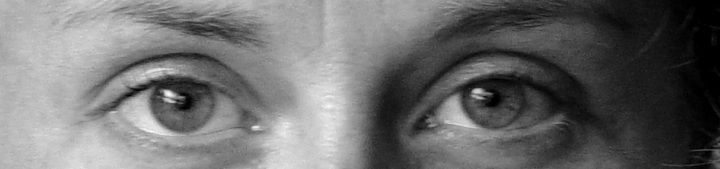 |
| Henderson, J., Hurly, T. A., Bateson, M. and Healy, S. D. (2006). Timing in free-living rufous hummingbirds (Selasphorus rufus). Current Biology 16: 512- 515. PDF. |  |
| Bateson, M & Healy, S. D. (2005). Comparative evaluation and its implications for mate choice. Trends in Ecology and Evolution 20: 659-664. PDF. | 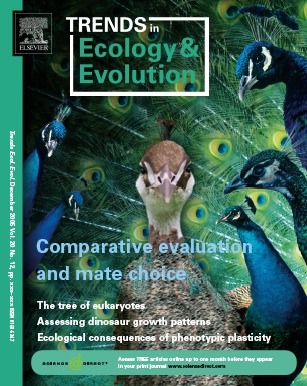 |
Bateson, M. (2004). Mechanisms of decision-making and the interpretation of choice tests. Animal Welfare 13: 115-120. PDF.
Bateson, M., Healy, S. D. & Hurly, T. A. (2003). Context-dependent foraging decisions in rufous hummingbirds. Proceedings of the Royal Society B 270: 1271-1276. PDF.
Bateson, M. (2003). Interval timing and optimal foraging. Functional and neural mechanisms of interval timing. W. H. Meck. Boca Raton, FL., CRC Press. PDF.
Bateson, M. (2002). Recent advances in our understanding of risk-sensitive foraging. Proceedings of the Nutrition Society 61: 509-519. PDF .
Bateson, M. (2002). Context-dependent foraging preferences in risk sensitive starlings. Animal Behaviour 64: 251-260. PDF.
Bateson, M., S. Healy and T. A. Hurly. (2002). Irrational choices in hummingbird foraging behaviour. Animal Behaviour 63: 587-596. PDF.
Bateson, P. and M. Bateson (2002). Post-weaning feeding problems in young domestic cats - a new hypothesis. The Veterinary Journal 163: 113-114. PDF.
Bateson, M. (2001). Interval timing. Frontiers of Life. D. Baltimore, R. Dulbecco, F. Jacob and R. Levi-Montalcini. New York, Academic Press. IV: 241-250.
Paule, M. G., Meck, W. H., McMillan, D. E., McClure, G. Y. H., Bateson, M., Popke, E. J., Chelonis, J. J. & Hinton, S. C. (1999). The use of timing behaviors in animals and humans to detect drug and/or toxicant effects. Neurotoxicology and Teratology. 21: 491-502. PDF .
Bean, D., G. J. Mason and M. Bateson. (1999). Contrafreeloading in starlings: testing the information hypothesis.Behaviour 136: 1267- 1282. PDF .
Bateson, M. and A. Kacelnik (1998). Risk-sensitive foraging: decision making in variable environments. Cognitive Ecology. R. Dukas. Chicago, Chicago University Press. pp. 297-341. PDF .
Kacelnik, A. and M. Bateson (1997). Risk sensitivity: cross-roads for theories of decision-making.Trends in Cognitive Science 1: 304-309. PDF.
Bateson, M. and A. Kacelnik (1997). Starlings' preferences for predictable and unpredictable delays to food. Animal Behaviour 53: 1129-1142. PDF.
Kacelnik, A. and M. Bateson (1996). Risky theories-the effects of variance on foraging decisions. American Zoologist 36: 402-434. PDF.
Bateson, M. and A. Kacelnik (1996).Rate currencies and the foraging starling: the fallacy of the averages revisited. Behavioral Ecology 7: 341- 352. PDF.
Bateson, M. and S. C. Whitehead (1996). The energetic costs of alternative rate currencies in the foraging starling. Ecology 77: 1303-1307. PDF.
Bateson, M. and A. Kacelnik (1995). Accuracy of memory for amount in the foraging starling (Sturnus vulgaris). Animal Behaviour 50: 431-443. PDF.
Bateson, M. and A. Kacelnik (1995). Preferences for fixed and variable food sources: variability in amount and delay. Journal of the Experimental Analysis of Behavior 63: 313- 329. PDF.
Cook, S. E., J. G. Vernon, M. Bateson and T. Guilford. (1994). Mate choice in the polymorphic African Swallowtail butterfly, Papilio dardanus: male-like females may avoid sexual harassment. Animal Behaviour 47: 389-397. PDF.
